May 29, 2026
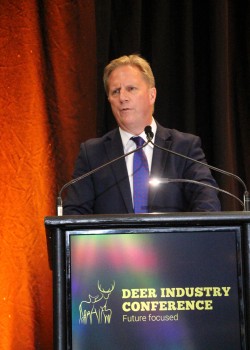
Minister Todd McClay
The 2026 Deer Industry Conference in mid-May brought farmers, processors and sector leaders together in Palmerston North for the industry’s flagship annual event. Featuring updates from DINZ leadership, summaries on the key areas of work, Q&A sessions, informative and entertaining speeches, and an address by Trade Minister Todd McClay, the programme reinforced the importance of staying connected across the value chain in a fast-changing global and regulatory environment, providing a timely forum to take stock of progress and look ahead to the opportunities and challenges shaping the sector.
In their State of the Industry address, DINZ Board Chair Paddy Boyd and CEO Rhys Griffiths delivered a message that was both grounded and forward-looking, acknowledging the pressures facing the sector while reinforcing a clear pathway ahead. Boyd emphasised the ongoing importance of promoting deer within mixed farming operations, particularly their contribution to overall farm resilience. Getting that message out to farmers, especially younger farmers, will be key.
“There are plenty of examples out there of mixed farming systems that have proven when other parts of the business are having it tough, the deer side has kept the dollars rolling in,” Boyd said.
He also reassured the audience that engagement with OSPRI remains a priority, with a focus on ensuring the upgraded NAIT system is workable in practice, cost-effective, and fit for purpose. At the same time, he flagged continued vigilance around wild venison risks, stressing the need to safeguard the industry’s long-term investment in quality assurance and reputation.
Building on this, Griffiths recognised the extended decline in national deer numbers but pointed to early signs of stabilisation, with initial modelling suggesting a modest lift of between 1– 3 percent. He acknowledged that while velvet returns last season fell short of expectations, this was largely linked to market manipulation, combined with an oversupply of larger Korean grade product. He addressed concerns about bad behaviour within parts of the velvet supply chain, signalling an enhanced DINZ focus on strengthening supply chain discipline and integrity as a key priority.
“Somewhere between the farm gate and the consumer, too much of our hard-earned value is being trapped. We have to fix that,” Griffiths said.
When asked to reflect on the annual event, Griffiths said, “In the days after, I heard from several industry stalwarts who said that this year’s conference was ‘one of the best in years’, and that is coming on the heels of last year’s big [50 years of NZDFA] celebration in Queenstown. It was back to business this year, looking ahead to where the challenges and opportunities lie.
“More than anything else, I was excited to have a full DINZ team there and ready to talk about their portfolios of work. For various reasons, we haven’t had a full team since [former DINZ CEO] Innes Moffatt stepped down in early 2024, so to have our Markets and QA portfolios now fully resourced and on a roll was great. And I think the farmers appreciated that also.”
The DINZ Board Q&A and Venison Marketers Panel followed the State of the Industry address, both of which were well-received, particularly the latter for the level of detail around what in-market activities are happening to extract greater value. (Check out this issue’s North American Retail Accelerator programme feature on Silver Fern Farms here, or see previous coverage from the other companies here, here, or here.)
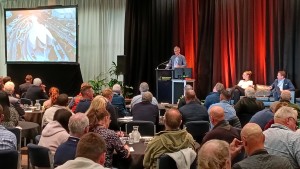
DINZ Markets Manager Terry Meikle gives an update.
DINZ Markets Manager Terry Meikle opened with a clear focus on strengthening the value proposition for New Zealand farmed venison, particularly in the US, where changing food policy and consumer expectations are creating new opportunities. The emphasis is on leveraging venison’s proven health credentials and functionality as a key point of difference. At the same time, with supply currently tight, the message was that now is the ideal window to refine the European strategy — prioritising partnerships with customers who value the New Zealand provenance story and production systems, rather than relying on traditional commodity channels.
For velvet, the strategy centres on building value through science, partnerships, and market alignment. In South Korea, DINZ will continue working alongside leading companies in the health functional foods space, where strong scientific evidence is increasingly supporting global ambitions. In China, the focus remains on deepening relationships with partners who recognise and value the quality systems underpinning New Zealand velvet.
Behind the scenes, market access work — a critical enabler as the industry looks to grow and diversify exports for co-products — continues to progress.
Quality Assurance Manager Merryn Pugh gave a back-to-basics summary of the work in play since hitting the ground running after last year’s conference. “If the foundations aren’t right, nothing built on top will stand,” Pugh said.
In a presentation that struck a firm but supportive tone, Pugh reinforced that the deer industry’s quality assurance systems – spanning supply chain compliance, animal welfare, and traceability – are non-negotiable. These standards are fundamental to meeting both market expectations and regulatory requirements, underpinning the credibility of New Zealand’s deer products in premium global markets.
At the same time, she acknowledged that these systems must be practical, cost-effective, and deliver real value on farm. Strong quality assurance is ultimately about more than compliance; it is about maintaining trust and confidence in our products, which should deliver a premium all the way through the value chain back to the farm gate.
DINZ’s Environmental Stewardship Manager Luka Jansen outlined an evolving policy landscape shaped by ongoing RMA and local government reforms. Within that context, recent progress was highlighted as a positive step for the deer industry — particularly the recognition of farm plans as a risk-based, practical tool for managing environmental outcomes, rather than relying on one-size-fits-all rules that don’t reflect the realities of farming deer. The removal of biogenic methane pricing obligations was also noted as a significant win, alongside the introduction of DINZ’s new climate change strategy.
While these developments are encouraging, Jansen reinforced that the work doesn’t stop here. Continuous improvement in environmental performance remains essential, not just to meet expectations, but to strengthen the industry’s position in the market. Now is time to focus on using that performance as a point of differentiation, says Jansen.
The day ended with Peter Savage, from BNZ Agribusiness, giving a rundown on how the banking sector views deer farming and what can be done to manage risk appropriately, before The Hon. Tim Groser gave an entertaining yet informative keynote speech on his experiences in international trade negotiations.
At the Silver Fern Farms-sponsored dinner, industry achievers were acknowledged. John Scurr was awarded NZDFA Life Membership, with former NZDFA Chair David Stevens saying that “John had shown exceptional leadership during transition to the new DINZ and NZDFA structure in the early 2000s.”
Ian Scott was acknowledged for his development and longstanding contribution to the National Velvetting Standards Body.
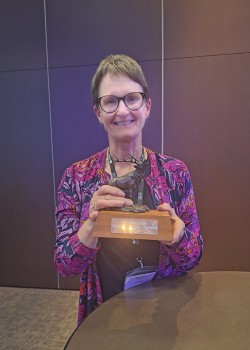
Lynda Gray, editor of Deer Industry News, took home the Deer Industry Award for “outstanding contribution to the industry.”
The Matuschka Award recipient for grassroots contribution to the deer industry went to Bay of Plenty Branch Chair Liz Love, while the Deer Industry Award for outstanding contribution to the industry went to Lynda Gray, editor of Deer Industry News and author of In Hindsight: 50 Years of Deer Farming in New Zealand.
The conference reinforced a positive, forward-looking deer industry that is firmly focused on the future and increasingly shaped by market realities, with strong engagement across the value chain highlighting a clear commitment to differentiation in premium markets. Central to this is capturing and fairly distributing value through farming credentials, product quality, and proven claims, supported by science and aligned with consumer demand.
As the industry moves further into an era defined by evidence-based storytelling and verified product attributes, there was a shared sense of optimism that, while challenges remain, the sector is well positioned to adapt, lift performance, and meet the expectations of modern, high-value markets.